Early Web Aesthetics
The early web was a vibrant, chaotic landscape where personal pages, animated buttons, and maximal DIY typography flourished before standardized layouts or mobile grids narrowed the field.
1 of 4
Visual archive
Visual Archive
Badges, buttons, Y2K motifs, and archival screenshots show how early pages treated decoration as identity, invitation, and proof of presence.

Collection object
Collection file
Welcome GIF
The object preserves an important early-web pattern: pages announced themselves with movement, invitation, and visible self-presentation instead of seamless polish.
Welcome GIF. Localized early-web welcome GIF used to show how personal pages announced arrival with motion, hospitality, and visual noise. Project asset fallback; original GeoCities record retained in sources.

Collection object
Collection file
Banner GIF
Moving banners helped transform static pages into theatrical surfaces. They worked as stage dressing for self-authored online identity.
Banner GIF. Localized decorative GIF fallback used in place of an unavailable GeoCities banner capture. Project asset fallback; original GeoCities record retained in sources.

Collection object
Collection file
Animated Button
Compact animated graphics collapsed signage, interface cue, and decoration into the same visual object. Navigation and ornament were rarely cleanly separated.
Animated Button. Localized Y2K next-button graphic representing the compact navigational ornaments common to personal-page cultures. Project asset fallback; original GeoCities record retained in sources.
Collection object
Collection file
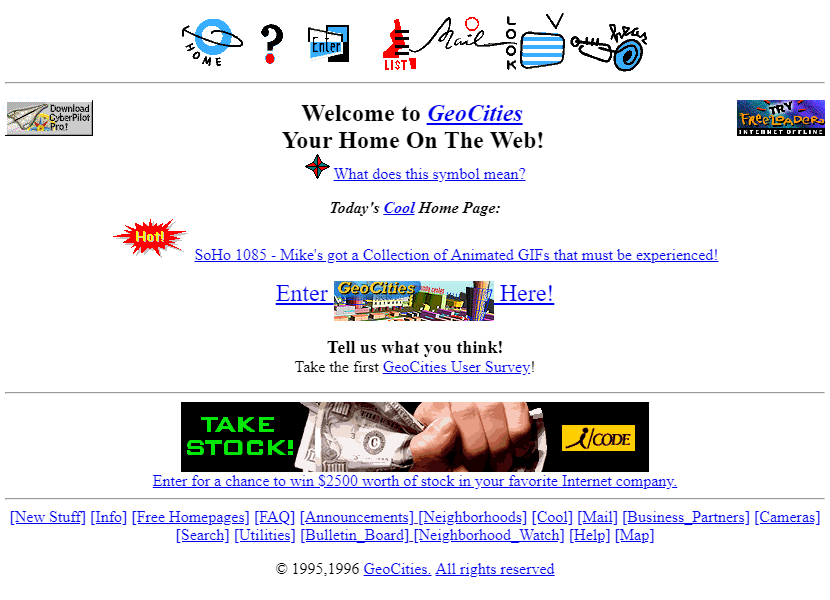
GeoCities Screenshot
The screenshot makes clear that directory structures, dense lists, and visible categorization were core features of early personal publishing, not failures of taste.
GeoCities Screenshot. An archived GeoCities homepage capture showing the neighborhood-directory logic and dense link structure of the early public web. Localized project copy of the documented GeoCities homepage capture referenced in the source archive.
Context module
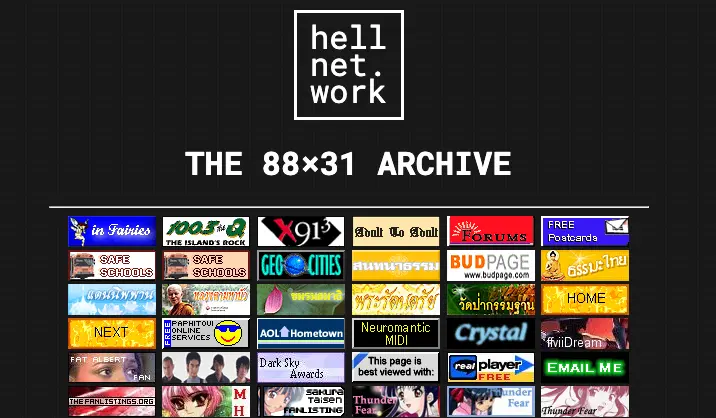
Web Badges
Small 88x31 graphics signaled identity, taste, and membership across the early web. They spread through copying and remixing rather than through formal design systems, which is exactly why they mattered.
- Best Viewed in Netscape
- Made with Notepad
- Join My Webring
- Get Flash Player
Context module
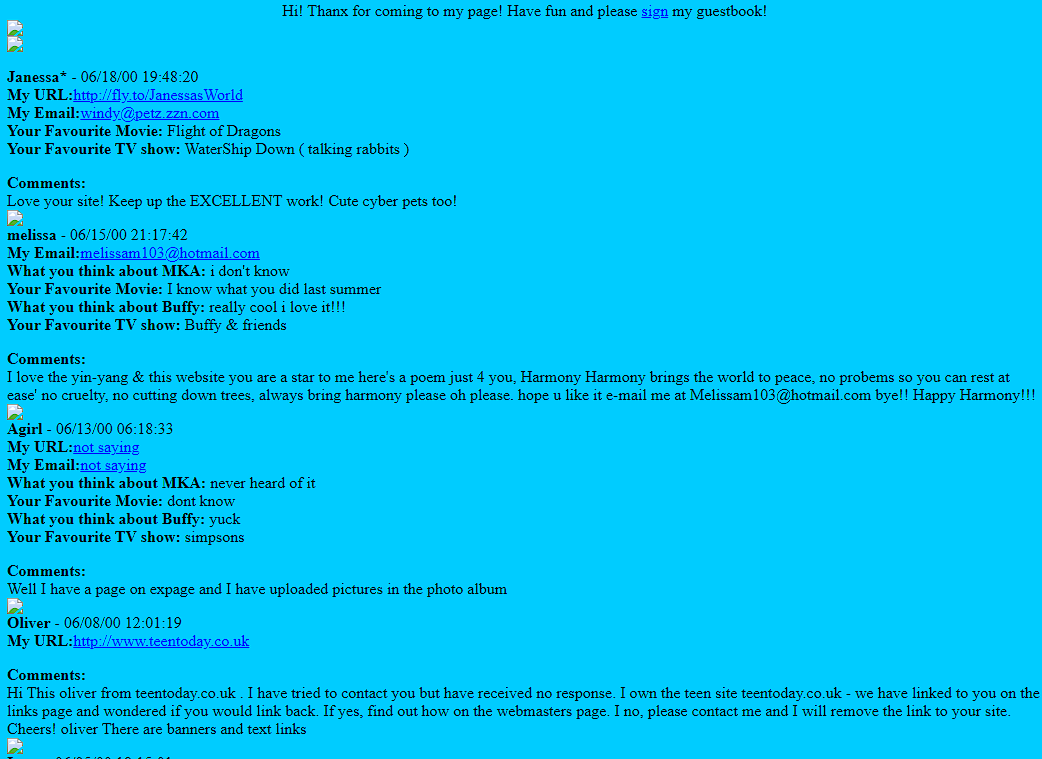
Guestbook Entries
Guestbooks captured the social layer of personal pages before feeds. Visitors left public traces, jokes, and reciprocal invitations, turning every page into a lightly moderated commons instead of a private dashboard.
- Love the glitter text!
- Signed your guestbook :)
- Come visit my webring
- Best viewed on CRT
Chronology
Era Signals
- 1995
GeoCities and personal hosting expand who can publish a homepage without institutional backing.
- 1998
Web badges, GIF buttons, and webring links become shorthand for belonging and technical identity.
- 2003
MySpace customization pushes profile pages closer to public self-branding and social performance.
- 2005
Y2K visual memory begins hardening into a recognizable style language for later revival.
References
Selected source records
secondary
GeoCities (Wikipedia)Background on GeoCities culture and the democratization of web publishing.
secondary
Myspace (Wikipedia)Context on customization culture, social profiles, and public identity performance.
secondary
Graphics Interchange Format (Wikipedia)History of GIF use and its role in early web animation.
secondary
Y2K aesthetic (Wikipedia)Defines core Y2K visual traits and common motifs.
secondary
Web badge (Wikipedia)Background on 88x31 badge culture and its role in early-web identity.
archive
GifCities (Internet Archive)Archive of GeoCities-era GIFs and buttons used as stylistic evidence.
directory
88x31 Archive (Jordan Eldredge)Curated archive of classic web badges used to illustrate early-web identity signals.
Era commentary
What changed visually
GeoCities and MySpace made visual identity both intensely personal and radically public. Users layered layouts, custom colors, badges, and animated graphics into online personas that behaved like both diaries and performances.
The DIY graphic language of GIFs, custom HTML, and improvised collage prioritized experimentation over polish. That messy visual vocabulary never disappeared; it survives as a design memory later eras keep revisiting and remixing.